


- History for Peace
- Feb 24
- 22 min read

We live in a time when narratives about the past can be found everywhere—on social media, in books and pamphlets and in dinner table conversations. Many of these narratives are biased and inaccurate, yet they inform the ‘commonsense’ we have about history. How do we articulate what constitutes history in an era marked by rumours and forwards? How do we understand history in terms other than heroism and glory? And how do we explain the logic behind historical arguments or what constitutes a ‘historical fact’?
In this talk, I wish to focus on the premodern past—not only because it is an area that I’m familiar with —but also because it is the site of most mythological fabrications. What people think they know about the ancient or medieval past are often the half-memories of textbooks or perceptions shaped by religious traditions, amplified by the noise and heat of the political discourses that surround us. In such a climate of opinion, it becomes particularly difficult to talk about what the past was really like rather than what people would like it to be.
The ancient past, in particular, is often seen as a space of glory, an arbiter of tradition, a pinnacle of authority. We assign certain kinds of authority to the distant past and this affects both our imagination of the past and interpretation of the present. As the quip from the serial Pataal Lok would have it, ‘Waise toh yeh shastron mein likha hai, par maine WhatsApp par padha hai (Although it is written in the shastras, I have read it on WhatsApp).’ When people imagine the past only in terms of certain texts or traditions, it becomes all the more difficult to question these idealized perceptions. In a contested present filled with heightened emotions and sentiments, it is difficult to occupy the rational ground of history. Which is why I want to use this occasion to talk about evidence and expertise, communication and the classroom. I want to ask: How do we understand the role of the historian? What is the responsibility of the historian in our world today?
One of the ways of starting this conversation would be to ask, how do people come to history? People approach the past from a range of perspectives and the motivations are rarely purely academic. Sometimes, they come with deeply personal questions, viewing it as a means of building connections and establishing roots. On other occasions, the past is a space of astonishment and wonder, where fascination with heritage or pride over past glory fuels a personal Instagram page. But there are also people—whom I’m sure you have met—who will tell you that history is a boring subject based on rote learning, an endless assemblage of dates and dynasties. And for me, as an academic historian, one of the most unacceptable things about the last decade has been the idea that history is something anyone can do. Retired bankers, uncles in the park, my sister-in-law’s mother-in-law’s cousin’s wife will all stop you and proclaim their authoritative understanding of history. So, whether we like it or not, history is everywhere and narratives about the past, narratives purporting to be history, are also everywhere.
In such a situation, asking ‘What is History?’ might seem like the most basic of questions. Perhaps it even sounds banal. But in order to explain what is history, it is equally important to explain what is not history. We need to recognize that not all narratives about the past constitute history, even as we engage with them.
So, to begin: History is not an account written by victors. The texts and artefacts that are our sources for the past are often embedded in circuits of power, but this does not mean that we cannot write ‘histories from below’.
History is not polemic. Today, it would seem that all cultural conflicts are about history, about the ways in which we approach an embittered, embattled past. But historians do not produce a past that pleases people—of whatever political persuasion. Instead, it is our job is to understand the past in all its complexity and also to explain it better.
History is not a battle of perspectives. True, the past constitutes a resource that is drawn on in a range of discourses. Politicians have their own versions of the past, as do journalists or influencers. But this does not mean that the study of history is reducible to whatever vantage point from which we view the past.
History is not heritage, which means that it is more than a set of inheritances. Even as the past exists within us and is part of our lives, the study of history does more than simply constructing a lineage for the present. Instead, it constitutes an active, critical enquiry and for this reason, how we tell the story of the past becomes an issue of crucial significance.
As historians, we are memory keepers and story-tellers. But we are more than that. For me, the study of history inhabits a halfway-house between the humanities and the social sciences, between enchantment and analysis. Precisely because history is not only about narrative and perspective, but also about explanation, it becomes important to consider the past on its own terms—through the evidence of the sources—and to explain how historians think. Doing so involves talking about the historical method. To put it simply: the historical method means a commitment to the idea that we do not take a narrative down some predetermined direction, but allow it to follow the path laid down by the sources.
Sometimes it is easy to prove or disprove a story by fact-checking, a method commonly used by journalists. For example, a WhatsApp forward, that might still be circulating, said:
Most of us know 14th feb.as valentine Day..
BUT..
In the morning of 14.02.1931 at Lahore, the legendary Bhagat Singh, Rajguru & Sukhdev were hanged to their deaths..
We only celebrate valentine day..
Let us pass this message to every 1 we know, to salute and pay respect to their sacrifice also..
Let Us Be An Indian First..!!
A simple fact-check can disprove this claim, citing evidence to show that Bhagat Singh, Sukhdev and Rajguru were, in fact, executed on 23 March 1931. But on other occasions, it is not simply a matter of disproving a false statement or correcting some detail. Instead, we have to confront deeply embedded perceptions and strongly held beliefs. Often what are presented as ‘facts’ are narratives which, knowingly or unknowingly, espouse political or cultural agendas. Occasionally such narratives appear as questions in the classroom and they do not always have easy answers. They have led me to confront my own certainties or rethink the ways in which I make an argument. Let me put before you three such ways in which the classroom has pushed me to think.
I have organized this talk around three questions. They are: ‘What is a historical fact?’ ‘Who is a foreigner?’ ‘And where am I in the story?’
What is a Historical Fact?
The idea of history has come to be tied to the narrative of the nation. This is the case not only in India, but in nation-states across the world. As a result, certain connections tend to be taken for granted. For instance, if you pick up a one-rupee coin and see the Ashok chakra from Sarnath emblazoned on it, along with the phrase ‘Satyameva Jayate,’ you will automatically connect this inheritance with the country to which you belong. On either side of the official emblem stand two words—India and Bharat. It is easy to make the link: Bharat or Bharatavarsha is a word which we are told, forms a bridge between past and present; it is a word our ancestors used to describe the country we call India. As a student of mine would have it, ‘Bharatavarsha is a 5000-year-old fact.’
In his brilliant essay, ‘The Concept of Bhāratavarṣa and its Historiographical Implications’, the historian B. D. Chattopadhyaya wrote:
We have been brought up from our early childhood on the idea that the country we live in is Bhāratavarṣa which is India and which is also a map with specific boundaries, separated from other countries with similar maps indicating them. The partition of India in 1947 changed the map, but the notion of Bhāratavarṣa and the name remained, conveying, as it did to our predecessors, the image of a country which has forever been there and will so remain despite the change in the map.[i]
And yet, Chattopadhyaya asks us to consider that what we know today was not always so in the past. Often, it had a different form. For this reason, we cannot slide easily between past and present believing that they represent a continuum.[ii] Let me explain what this means.
Today, we use coins as a medium of currency, but tomorrow, the one-rupee coin may become an alien artifact in a digital world. Today, on this coin, India and Bharat stand as equivalents, words that can be used interchangeably. Tomorrow, the picture might change, with one word gaining ascendance. Today, the words ‘India’ and ‘Bharat’ represent the opening line of the Constitution—‘India, that is Bharat, shall be a union of states’—but the vocabulary of the Constitution is also the product of decisions taken at a particular historical moment. As the arguments recorded in the Constituent Assembly debates show us, there was considerable disagreement over the name(s) chosen to refer to the new republic.[iii]
Setting aside this modern history, what did the idea of Bharatavarsha mean in times gone by? Here is a verse from the Vishnu Purana that you often find quoted on social media:
uttaraṃ yat samudrasya himādreścaiva dakṣiṇaṃ
varṣaṃ tad bhārataṃ nāma bhāratī yatra santatiḥ
That which lies to the north of the ocean and to the south of the snow-clad mountain, is the Bharata varṣa, where the progeny is called Bhāratī.[iv]
On the face of it, this seems recognizable. It looks like the country we know! The frame of the nation is one that we are born into and we find ourselves believing in it intuitively. The study of history, however, requires a measure of distance. It requires that we step back from the current moment to evaluate the evidence on its own terms.
Moving out from this verse into the larger text in which it is located, you will find that the discourse on Bharatavarsha in the Puranas is not geographic so much as it is cosmographic. This means that the imagination of the world reflected in it had more to do with how people imagined their place in the cosmos rather than their identification with any particular country. Such visions were not uncommon: if you look at a map of the world as depicted in the Jaina religious tradition, you will see that the world at the centre, populated by people, is but one of many worlds. Even in the Arab geographic tradition, the thirteenth century map of the world from the Kitāb Ghara’ib al-funun wa-mulah al-uyun (Book of Curiosities of the Sciences and Marvels for the Eyes), is very different from what you would consider the map of the world. That is because these ideas come from a time before maps, before the evolution of concepts such as latitude and longitude.
The idea of Bharatavarsha, then, is an idea that needs to be considered on its own terms, in different contexts and without necessary reference to nationalism. When we yoke history to the task of nation-building, we create a seamless historical narrative from a collection of fragments, papering over the gaps. Studying the idea of Bharatavarsha as a historical problem, however, tells us that words hold complex histories within them. The same word can mean different things at different times. To capture these different meanings is not an easy task: it requires that we understand that central to any historical endeavour is a recognition of change over time.
So, in response to the statement that ‘Bharatavarsha is a 5000-year-old fact’, I would say only that a historical fact cannot be a primordial entity or a self-evident reality. It always has a context, it builds relationships. It needs to hold hands with other texts, other references, other contexts, because it only acquires significance in relation to them. A historical fact cannot stand alone, especially not for five thousand years.
Who is a Foreigner?
If we see the past as a mirror of the present, we impose our forms of identification upon a world where they did not matter. This is true not only for national frames, but also for ideas of belonging—notions such as ‘Indian’ and ‘foreign’ that populate websites and many textbooks.
We live in a world of paper and passports, identity documents and Aadhaar cards. Being stamped and measured by the offices of the state practically from the time we are born, we presume that the same must hold true for people in the past. In doing so, we forget that the history of India is part of the story of the larger Indian subcontinent. It is a history of movement and migration that opens out into the Indian Ocean world.
Let me tell you once such story about a man who moved across frontiers. It is about a Jewish merchant called Abraham Ben Yiju, who lived in Malabar between 1132-1140 and then again between 1145-1149. His story has been told by many people, including by one of our most famous novelists.[v] We keep returning to it because it tells us something of the complexity of people’s lives.
Ben Yiju’s life has been reconstructed through shreds and scraps of evidence preserved at the Genizah at Old Fustat in Cairo. When it was rediscovered in the 19th century, the Cairo Genizah contained prayers and letters, poems and spells, recipes and children’s exercise books—‘a vast communal paper-bin’ made up of scraps of paper which could not be destroyed because they contained the word of God on them. From this rubbish-heap of history a whole cast of characters emerges—Abraham ben Yiju, his wife Ashu, his brother-in-law Nayar, his slave Bomma and his trading partners and business associates such as Khalaf Ben Isaac and Madmun Ben Hasan.
Ben Yiju had three children with Ashu and we know from references to her brother Nayar, that Ashu was a woman of a Nair clan belonging, therefore, to a matrilineal community. Within the rules of Nair kinship, Ashu and Ben Yiju’s children belonged to her family; their father could come and go. Among medieval trading diasporas, it is likely there were many such wandering fathers, whose children were absorbed into the local communities of their birth.
But Abraham Ben Yiju was different. He did not have any Jewish wife and children waiting for him in Aden and he was keen that his children inherit his wealth. The problem was that they were not Jewish and where he came from only ‘legitimate’ Jewish children were allowed to inherit their father’s property. As the historian of Malabar, Ophira Gamliel, shows us in her recent work, in the face of the problem that confronted him, Ben Yiju came up with a stratagem. On a voyage to Yemen in 1132, he got a deed of manumission issued for Ashu, proclaiming that she was a slave girl whom he had purchased from her mistress. This deed, marked by careful phrasing, appears to reflect a situation of ‘fictive enslavement’, making it possible for Ben Yiju to claim that their relationship was legitimate in the eyes of Jewish law.[vi] Eventually, though, he had to call in a favour: it was only after the intercession of Madmun Ben Hasan, Ben Yiju’s business associate who had risen to the status of community leader in Aden, that the latter’s children were accepted as his legitimate offspring.[vii]
What Ashu thought of this deed of manumission or of her husband’s legal and business dealings is something we will never know. Her voice never appears in the records. But the evidence from their life together tells us that Ben Yiju changed. Leaving Malabar in 1149, he scribbled a luggage list which puts down a whole range of items that he was taking with him on his journey West. Elizabeth Lambourn, a historian of material culture, has written an entire book on this luggage list,[viii] but what I wish to point to just briefly are the food-items that he was taking: rice, ghee, mango pickle and dried fish, suggesting that his time in Malabar, with Ashu, had made Ben Yiju a ‘rice-eater’.
One way of reading Ben Yiju’s life is as a story of loss. The trading networks of the Indian Ocean brought people of different faiths and ethnicities together. The distances were extreme, the travel hazardous, what kinds of relationships could people build, what were those that they had to leave behind? We know this one story, but it is an infinitesimal fraction of the many stories we do not know.
Ashu and Ben Yiju’s union must have had its share of difficulties. It is well-known to Genizah scholars that Ben Yiju’s brother-in-law Nayar was a crook and a cheat. Gamliel’s recent work talks about the manifold complications of kinship in this union,[ix] but I will not go there. What is clear is that when you think of this marriage, traditional laws would have cast them out. What would a conservative Brahmin have thought of Ashu’s marriage to a Jew? What sense would Jewish Halakhic law have made of this union? And linked to this is the question, what labels do we use for them? In many ways, the labels we deploy—Indian, foreign, Jewish, multiracial, mixed, matrilineal—tell us more about ourselves than about these people and their concerns.
Asking whether Abraham Ben Yiju was ‘Indian’ or ‘foreign’ is as pointless as asking for his Aadhaar card. The forms of belonging that people had, the communities to which they belonged were different from those we have. So, even if the past is not a foreign country, it was certainly organized differently from the world we know.
Where am I in this Story?
The story of Abraham Ben Yiju is more the exception than the rule. Where the ancient and early medieval past is concerned, we look for people, but often there are only patterns. The most we can do is to remember that an edict engraved, a line drawn, a poem composed are all traces of human beings.
Even then, it tends to be the case that some regions and traditions appear more frequently than others. We know more about Magadha in the sixth century BCE than we know about Manipur. We know more about the histories of Sanskrit or Tamil than we know about any Adivasi language spoken in Central India today. In such a situation, a student may well come up to you and ask, ‘Where am I in this story?’
It is a fair question, but it doesn’t have an easy answer. To write histories of communities who didn’t take to writing until very recently, requires that we move outside the realm of the written word. This usually requires a turn to different kinds of sources—to archaeology, folklore, longue-durée ecologies and also reading the sources we have against the grain. Scholarship on Northeast India has often marshalled the colonial record to write this region into history.[x] But what does one do for the premodern past? Where is the understanding of the languages, kinship systems and ecologies of these regions in our textbooks? One of the ways of addressing this situation may be to see Northeast India, not as a border but as a continuum, linking up into broader circuits of South-East Asian history and the Indian Ocean world. Unless we see Indian history as part of a continuum, we will not be able to understand these histories, let alone bring them into the classroom.
I began with a one rupee coin. Let me end with a ten rupee note. If you look at the languages represented on it, you will see that not a single Indian language occurring on the note belongs to the Austroasiatic and Sino-Tibetan families. The Indian subcontinent is a space of great linguistic diversity, but mainstream conversations are usually about a few classical cultures. The absence of these histories from our everyday, from our national debates and conversations about culture, can perhaps be remedied by the work of historical reconstruction, by greater attention to mapping these regions through philological, linguistic, archaeological and genetic research. Sometimes it is possible to fill the gaps if you ask the right questions. But for that, you would first have to start asking these questions.
Questions and the Classroom
In talking about history, we are not discussing a petri-dish in a laboratory marked by carefully controlled conditions. Instead, we are talking about people and politics, about what appears, at the first glance, to be the unbridled chaos of society. We enter into this chaos, seeking to discern patterns, but no historian would claim that he or she completely understands the past.
As teachers and students of history, the classroom is the space we occupy. It is also the space that we must fill—with questions and conversation, discussion and debate. True, the classroom is a hierarchical space, unlike social media where all opinions are equal. But the classroom provides the grammar of democracy, the forms of engagement from which listening begins.
The conversations that we have in the classroom are part of conversations happening everywhere. For this reason, we sometimes skirt troublesome issues and retreat into the shadows of ‘political correctness.’ But as history teachers, we should never be afraid of bringing the world into the classroom. Rather, we should feel confident that we understand the present better because we know something about its past. Teaching history is, for me, the beginnings of a conversation about citizenship, a preliminary attempt at getting students to think critically about society. Let me explain what I mean by this.
Students come to the classroom bearing a set of experiences circumscribed by the life they know. Often this knowledge is rooted in family, caste or class, in what tend to be the fixed certainties of their lives. Our job as teachers is not necessarily to dispute these experiences, but instead, to make our students consider that while their experiences are a useful benchmark, they need to be evaluated and compared with experiences that other people bring.
Understanding another person requires more than an appreciation of their stories. It requires an active interest in the experiences they carry. If people constitute the social unit, then they are important both as individuals and as the aggregates they join up to become. The problem begins when a student finds that a fellow-student holds views that are fundamentally different from the truths that he or she takes for granted.
In such a situation, it becomes all the more important to set up the terms of debate. As a teacher in the classroom, I repeatedly emphasize that just because you don’t agree with what someone is saying does not mean that it is unworthy of analysis. Instead of a slanging match, we need the courtesy of conversation. Instead of binary debates we need an understanding of diversity.
But espousing such a pluralist pedagogy does not mean that we lapse into relativism or a situation where all arguments hold. The study of history has an evidentiary basis and understanding the evidence involves the acquisition of expertise. No one knows everything about the past. No one can acquire expertise over all its domains. But what we can do is to learn the process of weighing and measuring, the ability to examine an argument or evaluate the premises of a belief. One of the ways of doing this is to consciously set up juxtapositions, by connecting and comparing stories that can provide a deeper and more complex understanding of society.
Teaching history is a dialectical process. As a teacher, I learn from my students in the classroom. I also emphasize that what I am saying is not infallible, that the story of the past never remains static but goes through a process of constant re-evaluation. As someone who practises the craft of history, who teaches it or thinks about it every day, one of the things I can say with certainty is that the study of history involves asking questions. The very process of looking at a source—at any text, artefact, image, inscription or document that has reached us from the past—involves asking a set of questions of them. And because these sources do not speak back to us or else, they speak in multiple voices, the historian has to repeatedly interrogate them, to ask what they mean.
Given that we end up asking so many questions, historians tend to be irreverent beings. I believe this is a good thing at a time when too many people accept whatever they are told, unthinkingly. As a discipline that evaluates evidence, examines arguments and asks for empathy, the study of history is important for the practise of citizenship. For this reason, we need a public culture that values history, that questions certitudes till such time as they are sufficiently backed by proof. Such a public culture would also be one that values asking questions, however difficult or uncomfortable they might be.
Thank you.
Question and Answer Session
Audience Member 1: There is a concept of subjective and objective truth in history. For example, slavery was considered acceptable by Greeks but not by us today because we know better. Do you think thought is embedded with an emotional perspective? Do you think that truth can be objective? In the case of history, I get a bit confused about whether it is narrative bound or narrative free?
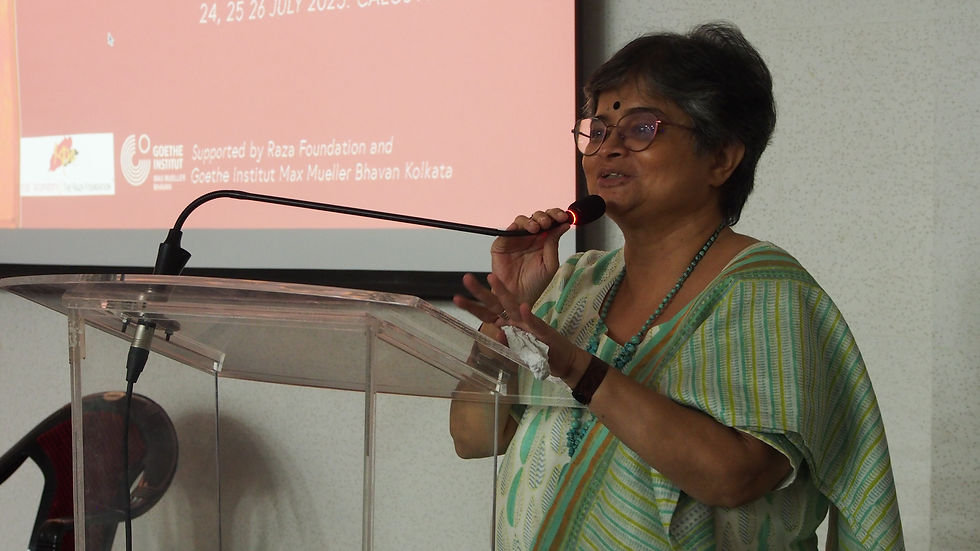
Meera Visvanathan: As I understand it, historical truth is evidentiary in nature. A proper historian is a cautious person who will always tell you ‘There is only so much I know or only so much I can say based on the sources.’ At the same time, as historians we operate from our vantage point in the present. So, we would have no hesitation in saying that slavery is wrong.
To write a history of slavery is a more difficult exercise since, as you pointed out, discussions on slavery are located within a whole range of moral positions. When you say that the Greeks thought slavery was right, the question you have to also ask, is what did the slave think about this? The slave was not a Greek, the slave did not enter the assembly, so how do we know what he thought?
Often, these sources don’t give us access to the experience of slaves. Sometimes you can turn to literature. If you look at, for instance, Tony Morrison's work, one of the things which she’s repeatedly talking about is the experience of slavery for black Americans. There is a long interview that she gives to the Paris Review in which she says there is a particular kind of bit that is put on the mouths of slaves, we know this was the case but what did it mean to have that bit in your mouth for days on end is a question we need to ask.
So, as I was saying, the truth in history is always in terms of what you can say from the sources, what you can recover from them. But often you can get better answers by looking at a greater range of sources and juxtaposing them, or by reading your sources against the grain.
Audience Member 2: Why are there problems with using a present-to-past approach to understand history? For example, pots that were found in Harappa were used to store water and grain. They are also used for the same purpose today. So why does this approach lead to misinterpretation?
MV: When we're talking about the past, there are things that we do not identify with, but there are also those situations where we can identify with people, their concerns and choices. If you find a broken pot at an archaeological site, you would need to ask when was it made? What was it used for? Who would have made it? It requires an exercise of the imagination. But it is also important to keep a measure of distance. For instance, if you decided to cook a curry in a terracotta vessel today, maybe it would have meat, maybe it would have tomatoes. But tomatoes only came to India in the fifteenth century, so they were not part of what was consumed in Harappa. Which is why I was saying that the study of history requires evidence but it also requires empathy, it also requires understanding that people in the past could be different from us.
Audience Member 3: Earlier you spoke about how everyone at this point claims to be a historian. There has always been a divide between academics and non-academics. The names of scholars you mentioned remain within books. It does not come down to people. This gap is often filled with influencers who claim to provide an overview in their ten-minute videos but are probably not well equipped to actually make sense of the subject and end up sharing their projections into the past instead of stating facts. How can we bridge this gap between academics and the public?
MV: I think the situation that we confront has to do the public culture we have and the value that we attach, as a society, to the study of history. The only way of sorting it out really is to have more conversations about the past. One of the things I so admire about the work that Seagull is doing is that we have so many schools and colleges across the country, we have so many teachers of history, but when you go around looking for the manuals, the conversations, or the lesson plans to help people to teach history in a creative way, there is just this big gap.
In our country, we often have a situation where we say ‘Oh we should be so proud of our past’. But when it comes to saying what does it mean to study history—to study it slowly, to study it with attention—people often don’t want to put in the time. As a result, the historical study of the past tends to get devalued and misunderstood.
Audience Member 4: In what ways can the Ramayana and Mahabharata be read as sources of history?
MV: Today we experience the stories of the Indian epics in multiple ways – you can view a Ram Leela, read an Amar Chitra Katha or watch a You Tube video. So clearly the stories that have been told to us have changed in their tellings over time. That is because these are not only texts but also religious, literary and performative traditions.
The problem begins when someone wants to link the story they know to the Sanskrit Mahabharata or Ramayanas. The first question that we have to ask is, when was this text written? Because it started as a story told by wandering bards. So the date of the events that are the heart of the story, are different from the date of the text that was written down. Essentially, these are texts that came down to us as manuscripts. Now the thing about a manuscript in South Asian monsoons is that it has a life of about 300 years. If you have a manuscript or a sacred text like this, in your home, in 300 years, it's going to fall apart. So what are you going to do? You're going to call a scribe who will copy it down and give you a new copy of the text. As a result, what happens is that the manuscript that you may be holding will date back to the 15th century but we know that the story goes back to the protohistoric period. The age of the text and the age of the manuscript is not the same thing. This is just one of the qualifications we need to make in the historical study of the epics. As historians, we cannot take these texts at face-value, even though there is historical material embedded in them.
Audience Member 5: The information that we have collected through satellite and internet allows us to have a better picture about what is going on than the models depicted in the books or narratives. The question is, what is going to be the proper history, the one we can see through satellites now or what we read in books from thousands of years ago when there was no such facilities? Which is more reliable? Which is real history?
MV: I am always wary of thinking that new technologies will solve all our problems. As historians, we know they are often subject to the same processes of discard and decay. For instance, the recordings of the first men on the moon are something we cannot access because the data format change. As time goes by, things get lost.
Also, the nature of how information is recorded will change from time to time. If you’re looking at the fourteenth century, you will have a manuscript. If you’re looking at the twenty-first century, you’ll have a video file. That’s a question of sources. Different periods will have different kinds of sources. There’s no one true or authentic history because there are different histories of different periods based on different sources.
One of the things that I tried to communicate here is that there are a whole range of sources, each of which needs their own kind of expertise. To look at the question of Bharatavarsha, you have to look at certain texts composed in Sanskrit called the Puranas. To look at the trading world of the Indian Ocean merchant, the Genizah records will be useful. And if you want to write the history of Assam in the early modern period, certain kinds of chronicles known as the buranjis are what you will use. But you also have new developments in archaeology, linguistics or genetics that can help us understand historical questions. This is why comparing, contrasting and juxtaposing the greatest available range of sources that we have is something that historians do. But we do it in response to a set of questions. The question you ask will determine what the sources that you use will be.
[i] B. D. Chattopadhyaya, The Concept of Bharatavarsha and Other Essays (Ranikhet: Permanent Black, 2017), p. 1.
[ii] Ibid., p. 2.
[iii] Catherine Clémentin-Ojha, 2014, ‘“India, that is Bharat…”: One Country, Two Names’, South Asian Multidisciplinary Academic Journal (10), https://doi.org/10.4000/samaj.3717.
[iv] Vishnu-Purana 2.3.1.
[v] See Amitav Ghosh, In an Antique Land (New Delhi: Penguin Books, 2009 [1992]).
[vi] Ophira Gamliel, Judaism in South India, 849-1489: Relocating Malabar Jewry (Leeds: ARC Humanities Press, 2023), pp. 74-78.
[vii] Ibid., p. 78.
[viii] Elizabeth A. Lambourn, Abraham’s Luggage: A Social Life of Things in the Medieval Indian Ocean World (Cambridge: Cambridge University Press, 2017).
[ix] Gamliel (2023), pp. 66-67.
[x] See, for instance, Jangkhomang Guite, Against State, against History: Freedom, Resistance, and Statelessness in Upland Northeast India (New Delhi: Oxford University Press, 2019).
Meera Visvanathan is an Associate Professor at the Department of History and Archaeology, Shiv Nadar University. Her areas of research and writing focus on the history of ancient and early medieval India. She has also written multiple book reviews and popular articles and delivered several presentations focused on public engagements with the past.


Comments