


On the 2nd of May 2026, History for Peace conducted a workshop for school students at South Point High School in Kolkata. Students belonged to different age groups––between 11 and 14 years of age i.e. studying in classes 7–9. The theme of this workshop ‘Sifting Fact from Fiction’ is something we had broached with teachers in the past: at the Professional Development Course 2025 and at the recently concluded workshops with the Teachers’ Centre. This time, Sunita Biswas, the facilitator for this workshop, explored the same concept via the study of a historical persona whose impression in the annals of history has now become the subject of much debate in social media, textbooks, YouTube videos and WhatsApp stories––Jalaluddin Muhammad Akbar.

Students first revised things they thought they already knew:
Akbar was a well-read monarch;
Akbar’s chief queen was Jodhaa Bai;
Akbar was ruthless with his enemies;
and so on.
With each statement being labelled True or False, students were asked how they reached that conclusion. After this students were introduced to textual primary sources that tell us about the reign of Akbar (from the perspective of the Mughal court) like the Akbarnama of Abul Fazl, the Muntakhab ut Tawarikh of Abdul Qadir Badayuni, writings of Jesuit priests at the court of Akbar etc. along with secondary sources on the reign of Akbar––the work of colonial, nationalist and revisionist historians and popular writers.
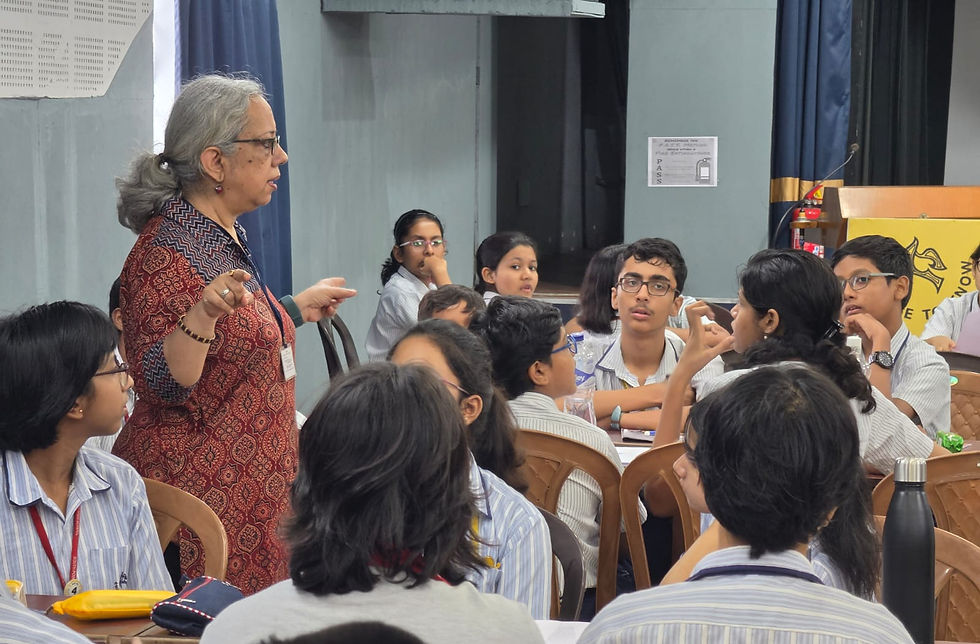
Students were then given translated sections from the Akbarnama, Badauni’s Muntakhab ut Tawarikh, Father Montserrat’s reflections and Ira Mukhoty’s monograph to read and discuss the readings according to the HAPPY framework.
H - historical context
A - audience
P - purpose
P – point of view
Y - why is it significant?
Students reflected on how a single statement carried the weight of so many different impressions, how, to construct the history of Akbar’s reign, a single ‘fact’ had to be extracted from such sources and corroborated with each other. If facts were so difficult to arrive at, what about the stuff of textbooks like: ‘Rana Pratap lost the Battle of Haldighati in 1576 and escaped on his horse, Chetak’? Students watched an Amar Chitra Katha video on this and reflected: does it make me feel as though Maharana Pratap lost or won? How was this feeling constructed and what were its consequences? Thus performing the same exercise students learnt how history was often retold with its influence on the affect privileged over the authenticity to the past.


Comments