


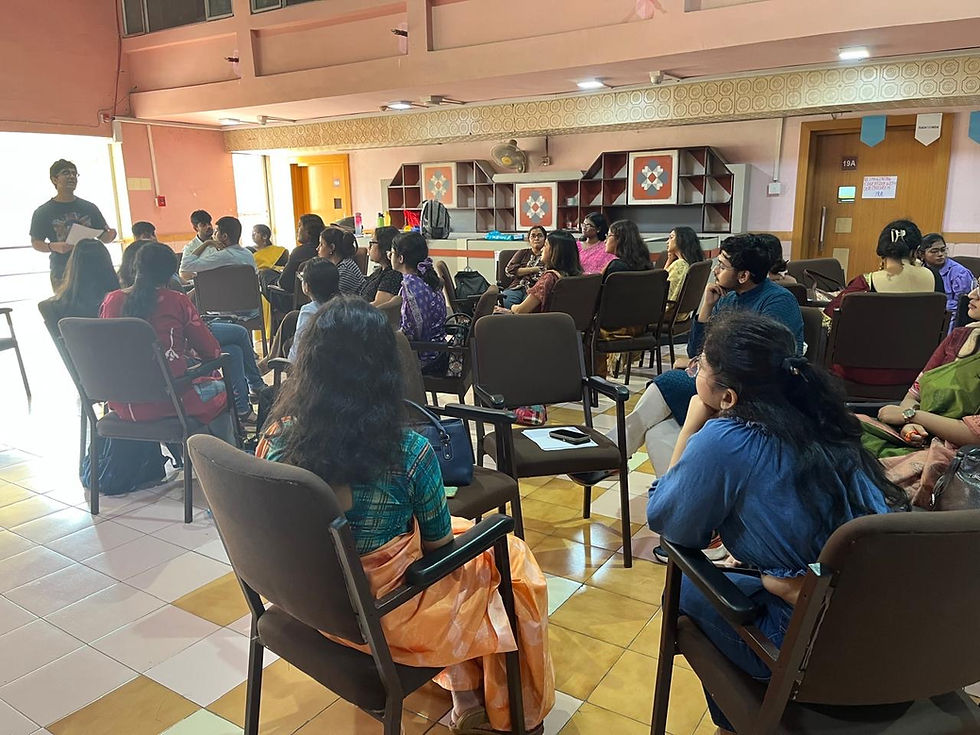
The workshop was conducted by Ira Bhaskar and was titled Doing History: Cinema in the Past and in the Present. Bhaskar used a presentation and clips from films to conduct it. At the outset, she set the tone for the presentation by stating that while filmmakers use the work of historians, their primary concern remains with the present; they talk about the present through the past. Through her presentation, she addressed questions pertaining to the relationship between cinema and history, how Indian cinema records the history of earlier periods, what issues were important to filmmakers in the past, and how these relate to those in the present, among others. As clips from films played, she also explained their elements to the audience, making it an enrapturing experience.
Bhaskar began with ‘mythologicals’, the type of films that birthed Indian cinema in the teens of the twentieth century. Naturally, D G Phalke was mentioned, as were Raja Harishchandra (1913), Lanka Dahan (1917) and Shri Krishna Janma (1918). Through these indigenous mythological stories and figures, Phalke was creating an original identity for Indians, thus earning such films the name, ‘nationalist cinema.’ The origins of Phalke’s desire to make films lay in The Birth, the Life and the Death of Christ (1906), said Bhaskar; while watching the film, Phalke kept seeing Shri Krishna and Shri Ramchandra, among others.
Bhaskar then moved on to the two genres of films that followed mythological in the late teens and twenties: ‘devotionals’ and ‘historicals’. Devotionals had a saint as their subject, while historicals focused on the life of a historical figure (kings, queens, et cetera). Returning to the statement she made at the beginning, Bhaskar pointed out that all these films were allegorical; they were as much about contemporary issues as about the stories they were narrating. The use of allegory was a political move: it allowed filmmakers to escape British censorship. When Bhakt Vidur (1921) portrayed Vidur from the Mahabharata wearing a Gandhi cap and spinning a charkha, it was banned by the British. Thus, these genres became instruments of cultural nationalism.
Besides attempting to create an Indian identity, films also displayed a vision of the India of the filmmakers’ dreams, of what it should look like. In the context of Gandhian politics on caste, films like Dharmatma were powerful critiques of caste prejudices. Bhaskar then showed us a clip from Sant Tukaram (1936), where enemy forces rush to arrest Shivaji. However, as soon as they grab him, he changes into someone else, and someone else looks like Shivaji! When they run to the next ‘Shivaji’, he changes again. Bhaskar read this scene as a reimagining of power and sovereignty as being distributed among the people, and not concentrated in just one individual. Justice was a preoccupation in films like Pukar (1939), which glorified it as the virtue par excellence for those in government.
A number of films released between the 1920s and 1940s were ‘socials’, addressing issues like Hindu-Muslim discord and atrocities on women. Bhaskar showed us a clip from Padosi (1941), a film advocating for Hindu-Muslim harmony. Cinema also responded to significant contemporary events, including the Partition (Subarnarekha, 1965) and the nationalist struggle. Between the 1940s and 1960s, films about the nationalist struggle deployed evocative songs majorly, besides using nationalist iconography. Bhaskar emphasised that around the 1960s, however, there was increasing critique of the government, rooted in disillusionment with the nationalist dream. Examples of such films included Awaara (1951), Shree 420 (1955), and Jaagte Raho (1956). Even Mughal-e-Azam (1960) questioned state authority, and portrayed the strained relationship between state and art.
The 1970s saw the rise of the Indian ‘new wave’, which addressed caste and women’s oppression, besides foregrounding the repressed histories of the Partition and communalism. This included films like Garam Hawa (1973), Tamas (1988), Salim Langde Pe Mat Ro (1989). Communalism has been a motif between 1980 and 2014, the period of what Bhaskar called a ‘tussle over the idea of India’, especially with regard to the rise of forces of Hindutva. She noted two important moments in this tussle: the demolition of the Babri Masjid and the Gujarat riots. Films like Bombay (1995), and Fiza (2000) and Hey Ram (2000) can be located within these two movements.
Bhaskar painted a grim picture of the relationship between cinema and history as it exists post-2014. Films like Padmaavat (2018) and Chhaava (2025) glorify Hindu, Maratha, and Rajput kings as brave, while Muslim ones as animalistic (see Alauddin Khilji in Padmaavat). Films like Dhurandhar (2026) and its sequel (2026) distort history and promote an extremely prejudiced perception of events. Moreover, Kashmir Files (2022) and Kerala Story (2023) promote concocted histories and social ‘realities.’ Not all is lost, however; even today, smaller filmmakers are fighting the Hindutva wave. Examples of such films include Dharm (2007), Shahid (2013), Nakkash (2019), and Mulk (2018). Bhaskar ended with a few unanswered questions, “Is everything over? Is there no scope for positive history?” or can we hope with Sahir Ludhianvi for ‘vo subah’ (that morning).
A question-answer session followed Bhaskar’s presentation. When asked ‘what has changed’ between then and now, she said that the poison has successfully spread. When asked what can be done about the situation, since the state and its resources are complicit, she said that the need is for a film like Pathaan that has a big budget and that disguises its ideology well. When a school student asked about the deletion of histories from textbooks, Uma Chakravarti (who was in the audience) was also asked to answer. She said that while the state deletes knowledge from books, sources and libraries are still open to us. We must find such alternate sources of knowledge and history. Finally, another audience member asked a question about how some people claim that films like Dhurandhar are for entertainment only and that one must not read too much politics into them, Bhaskar responded, visibly indignant, that such arguments are a smokescreen to hide the blatant communalism in such films.
The session then concluded, having explicated the linkages between Indian cinema and history as it has evolved over time.
This report has been written by Yusuf Ghazali, an undergraduate student pursuing history at the University of Delhi.


Comments