


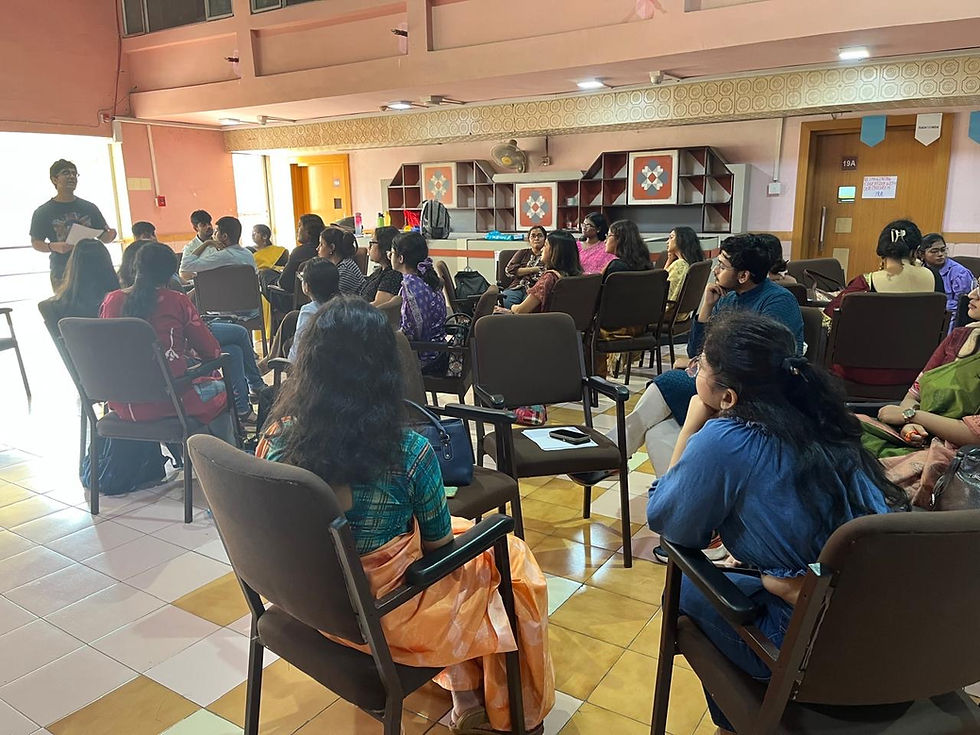
This workshop, conducted by Akshaya Mukul on the 24th of April gave participants a comprehensive and critical overview of the Gita Press’ publications. Since its inception in 1923, the Gita Press continues to enjoy a dedicated readership: the Press’ Stri Dharm Prashnottri has reached its 72nd edition with roughly ten lakh copies sold. Established in Gorakhpur, the Gita Press was founded by Jay Dayal Goyenka and Hanuman Prasad Poddar, businessmen who were interested in the Gita and the literary culture associated with it. The founders wanted their publications to be the voice of the Hindus. They believed in maintaining the varna-jati hierarchy and upheld the tenets of Sanatana Dharma. This workshop aimed to sensitise participants to the blatantly divisive nature of the Gita Press’ publications and its unwavering support for orthodox and outdated Hindu religious conventions. Mukul explained that the Gita Press has not steered away from this commitment and continues to abide by these founding principles.
The Gita Press began publishing its monthly Hindi magazine, Kalyan. The Press defended Sanatana Dharma and maintained that religion was the salvation for all evils in society. Further, it attempted to write a Hindu history which denied the incorporation of Muslim and British elements, seeing them as intruders who were antithetical to Sanatana Dharma. Poddar was against the Temple Entry Movement (1920s-1940s) and opposed inter-caste dining. Having been well acquainted with Gandhi, Poddar questioned his support for the Temple Entry Movement, given that the national leader was initially opposed to it. Poddar accused Gandhi of assuming a ‘western sense’ of social reform. The difference of opinion between the two individuals put a strain on their relations. Poddar also had strong resentment towards Ambedkar and his marriage to a Brahmin, claiming that there was a scientific reason for the practice of untouchability.
The Gita Press also spoke out against communism. An anonymous writer argued that communism was ‘a movement that attacked the superior God’. The Press claimed that the alternative to communism was the Gita, a spiritually ordained version of social and economic organisation. The Press learnt how to make pamphlets from the Left and then used it instead to create a counter-narrative in politics. They argued that communism did not make any provisions for women and that the system simply reduced women to vessels that quenched the thirst of men. They further proclaimed that the Ramrajya would make better provisions for women to work at home.
The Gita Press’ Kalyan intentionally created false narratives aiding Hindu-Muslim communalism. Poddar put up a 12-point program to stoke the fire of growing communal resentment. In essence he claimed that the Muslims could not fight effectively if the Hindus posed a strong unified front against them. The Press continued to produce communal pamphlets in 1946. After 1947, contributors to the Press had multiple policy suggestions for independent India, suggestions that are familiar to us even today; contributors believed that Vande Mataram should be the national song, the national flag should be solely saffron, the official language should be Hindi (in the Devanagari script, not the ‘corrupt’ Hindustani) and that there should be a pan-Indian ban on cow slaughter. Additionally, they were vehemently against the Hindu Code Bill and wrote multiple letters to Rajendra Prasad expressing their dissatisfaction with the same. They argued that the Bill would make women more powerful in Indian society, thus unfavourable. In recent writing, the Press has celebrated the Pran Patishtha (consecration) ceremony at the Ram Janmabhoomi temple, Ayodhya; a project that Poddar had supported since the 1950s. The Lok Sabha electoral victory of the BJP in 2014 was also similarly celebrated.
Mukul then explained the moral universe of the Gita Press. There were discussions on women’s rights and Hindu religious practices. Goenka was suspicious of women enjoying multiple freedoms in modern Indian society. Poddar argued that it was the duty of the women to procreate and nurture the inner lives of men, going on to justify child marriage. Poddar even attempted to justify sati using science and describing it as a purely natural phenomenon. He gave immense importance to the male child, believing that it was a woman’s duty to bear sons by practicing piety and self control. Poddar also championed male education; the Gita Press published textbooks like Balak ka Acharan which have become an important part of primary education in some parts of the country. Their most popular publication was Naari Ang, given as a parting gift to women when they got married. Even though we might assume that the popularity of the Press’ works has decreased in recent times, Mukul, using his ethnographic research, explained how many still hold a sentimental attachment to these publications.
The Gita Press continues to be strengthened by powerful aides and publishes work that celebrates the aforementioned themes. Mukul briefly touched upon the economics of the Press and how it is built on a ‘no profit, no loss’ system, backed by a very strong financial trust. The question-answer session looked into the unchanging nature of the Gita Press and the origins of its firmly held beliefs. In his concluding remarks Mukul pointed out that the Gita Press has encountered limited opposition over the decades. The workshop thus sought to trace the history of the Gita Press, problematising the ideological bent of its publications and how it remains detrimental to the social fabric of modern India.
This report has been written by Anjali Susan Abraham, an undergraduate student pursuing history at the University of Delhi.


Comments