


I am not a scholar.
What I wish to share with you here are some reflections around the work I do.
I will begin with briefly revisiting my personal history to make connections between stories, memories and identity, followed by insights into the socio political realities that led to our work and finally I will speak to how our work informs counter memory as an individual act of resistance.
But first, sincere and heart felt gratitude to Prof Angana Chatterji and the Berkeley Centre for Race and Gender Studies for inviting me and for making it possible for me to be here.
This is truly special.
I grew up in an upper middle class Gujarati Jain family. The stories I heard from my grandparents were rooted in the philosophy of Jainism. Non-violence, renunciation, detachment made up the core of the themes. Stories that demonstrated the strength of inner discipline; those that illustrated Ahimsa in its purest form—the idea that the most hostile being/situation can be disarmed by unwavering nonviolence. There were funny and ridiculous stories too, some even violent—about wars and conquests.
My favourites were their personal ones—my paternal grandparents migrating to Burma, their memories of life in an alien culture— adapting and being accepted despite stark differences in language, food habits, appearance, dress. My maternal grandfather’s memories of walking the streets of Bombay selling cotton fabric from a cart and how he eventually built a textile empire through sheer grit and determination.
Which of these stories shaped the person I am today—I don’t know. All of them perhaps? Some of them? Did I consciously pick their influences?
Years later, my children — growing up in a Punjabi family — heard a different set of stories: of Partition, of the food of Peshawar, the beauty of Multan. Of communities where friendship and coexistence were woven into daily life.
My Hindu grandmother-in-law, I was told, often wore a burkha embroidered by her own hands — not out of compulsion but out of companionship, because her friends wore them.
At weddings, separate kitchens were maintained out of respect for dietary customs — yet everyone ate together.
My father in law’s early education was in a Madrasa, up to grade 5, after which he studied at an Arya Samaj school till the time the family migrated.
These stories capture how memories shared across times and generations become our inheritance. An inheritance that perhaps shapes us in so many ways.
But memory is so fragile. It is so heavily dependent on the present we live in. Memory is so easy to manipulate.
Today, the narratives doing the rounds at family gatherings and on family Whatsapp groups—both maternal and paternal families are riddled with vilifying the ‘other’. The ‘other’ primarily being the Muslim.
Understanding the mechanisms and depth of the current environment of othering needs more time than what we have here today.
But I would like to give you a sense with just a few visuals doing the rounds on social media.
It’s hard not to draw parallels with Nazi Germany.
My father in law, who is 93 now, and spends most of his time watching television and reading Whatsapp forwards, has forgotten all the stories he told my children.
And he is not alone. On the one hand there is collective amnesia in relation to the past, deliberately brought on through erasure and on the other is the construction of a ‘new’ past that is selective and agenda driven.
Grandparents are but one source of stories. We encounter stories in the form of visuals every single waking moment. We imbibe stories through our encounters with people, places, cultures, experiences.
Stories are adventures. They are our shelters.
And when stories become selective they become conduits of indoctrination.

Over the past decade and a half, as I see the social fabric of India collapsing around me, I find myself increasingly revisiting two generations of ‘viraasat’ in my family.
I ask myself what has made us construct our past so differently in such a short time? Why have we become so rigid and obsessed with identities? Why are identities ONLY attached to religion? Why have we embraced hate? Why have we lost the ability to reason, to empathise, to stand up for justice?
I say ‘We’ because those of us who are incapable of embracing hate and continue to fight for a just, plural world, also share responsibility through our silence and complicity.
How did we get here?
And more urgently: ‘How are we going to find our way back? What are the stories we need to choose to tell our young? How are we going to ensure that the erasure and collective amnesia around us is replaced with critical remembrance.
This brings me to our work. And to Gujarat, 2002.
It started without warning. I was standing in my shop. One moment I was thinking about my nephew’s engagement and the next moment... A customer in the shop, a woman—she heard the sound before me. We both stepped out. We saw someone running. Behind him were seven others, maybe eight. Carrying sticks. The one in front was running towards me. His mouth was open, no sound coming out. I knew what I had to do. I stood in his path. He swerved to avoid me, but I held him. In that instant the boys caught up. They leapt at the man, jumped straight at him! And stamped him out. I heard the crunch of his bones as they broke him. In his final moment, he looked straight at me. The heat of his life was like a blaze in my face! And then…he was out. At the end of that first day, we heard the news. Two hundred dead. At the end of the next day, we heard the news. Three hundred dead. At the end of the month, we heard the news. Two thousand dead…[i]
This is an excerpt from Hidden Fires a playscript written by well-known Indian playwright Manjula Padmanabhan in direct response to the Gujarat massacres of 2002, in which Hindu extremists killed approximately 2,000 Muslims, looted and burned thousands of Muslim businesses and homes, publicly raped and killed hundreds of women and left more than 200,000 Muslims displaced. At the time called ‘communal violence’ and ‘riots,’ numerous sources including Amnesty International, a British High Commission investigation, the Coalition Against Genocide and the U.S. State Department now see what happened in Gujarat as a state-sponsored attempt at ethnic cleansing or genocide. The Chief Minister of the state then was our current Prime Minister.
Six high school students performed these monologues over several months, for audiences across the city. These monologues that brought the harsh realities of communal violence, prejudice and hatred to the fore, became the inaugural public intervention for a project called PeaceWorks.
We take pride in the diversity that is India. In reality, our young, coming from privileged backgrounds, are quite oblivious to this diversity. They grow up in the insulated social circle that mirrors their own class and more and more now their own religious background.
PeaceWorks set out to break this insulation, expose them to realities beyond their comfort and inspire them to own their ability to make meaningful change because of their privilege.
Focussing initially on the issue of communal harmony through arts based cross border initiatives with students in India and Pakistan. Eventually growing into a movement under the umbrella of Learning to Live with Difference.
The arts as a powerful tool in building a deep understanding of pluralism and justice has been the central pedagogical idea of our work. We also believe that deep transformative and change inspiring learning can only happen through lived experience. Through arts based workshops we brought together youth from very diverse backgrounds to stimulate their young minds into thinking, questioning, probing preconceived notions and prejudices and recognising and resisting stereotypes.
One of our early PeaceWorks volunteers, who performed Hidden Fires, says:
‘We were standing on stage and all the people were hearing us speak about the fact that these were our own brothers and sisters, and they were killed for no reason. And then, if people think about it a little, they have to realize that it was people like us who killed people like us. And that itself was very new and very, very different from what we had already heard about Gujarat. We all knew the political connotations as to why it happened, but we hadn’t thought about this aspect of it.’
Another young volunteer adds, ‘In Calcutta, it is always the political aspects that are hammered into us, but we so rarely get a chance to see the human side.’
The Gujarat pogrom was not the first time we saw clashes between the Hindu and Muslim communities.
We know of recurring episodes of horrific hate violence over several decades and not just limited to religious identity. People disadvantaged by caste have also faced the worst kinds of atrocities where the perpetrators have been individuals, mobs and the state too.
Hate thrives in many forms.
What is it that makes a human being embrace ‘Hate’? This is a question that plagued us as our work with young people grew in depth and scope. We asked ourselves, can our young understand the value of peace without understanding the root of conflict? With the arts based workshops model we began to feel restless with the numbers we were reaching. We asked ourselves: Is this enough? How can we do more? Meanwhile, we saw an alarming disintegration in the social fabric of the country once the BJP government came to power with an absolute majority in 2014. Overnight there was agency. Divisions that up until then were confined to pockets within communities, came to the forefront with a vast majority of the people making the newly elected government’s nationalist agenda their very own. We knew hate then, we knew violence too, but something is different now: We have cultivated a geography of hate, conjured so-called memories of ‘hurt sentiments’ that invite violence, that project extermination of an ‘other’ as the only way forward.
The Nationalist project was loud, it was convincing, it took over all public domains. In what felt like just a blink of an eye, we saw the idea of India going from secular liberalism to religious fanaticism.
Focussing only on values of tolerance and peace was not enough. We felt an urgent need to address conversations around identity, nationalism, democracy on the one hand on history, memory, bias and mindsets on the other. We felt an urgent need to expand our scope. We felt the need to work from within the education system.
And so, in 2015, as natural progression, History for Peace—a history teachers’ network in the sub-continent came into being with the objective of teaching history for peace and understanding.
In India the central education board designs syllabus and controls content of textbooks for English medium schools. Weaponizing the history syllabus and politicising textbooks has long been a reality. However, in light of the current government’s abrasive cultural stronghold, past attempts at politicising seem very mild.
School textbooks—especially in history—have been systematically revised. Chapters on the Mughal empire, caste discrimination, social reformers and even Gandhi’s assassination have been removed or truncated. Mythological narratives are often presented as historical fact, glorifying the ancient Hindu past, thus creating a monolithic national story that excludes minority communities, dissenting traditions, and complex truths.
Citizens who have the ability to think critically, empathise, respect multiple perspectives and fight for rights is crucial to a democracy.
When history teaching is reduced to patriotic celebration, it undermines these democratic capacities.
Let me share an example:
Over seven decades later, our history textbooks do not cover anything beyond 1947, however, a new supplementary textbook has been introduced across the country on ‘Operation Sindoor’ – a recent military response launched on nine alleged terror camps in Pakistan and Pakistan occupied Kashmir. Titled Operation Sindoor – A Saga of Valour for grades 3 – 8 [age 9 – 13] and Operation Sindoor – A Mission of Honour and Bravery for grades 9 – 12 [age 14 to 17] this supplementary textbook claims to highlight the courage of the Indian Army. In reality what it does is present a single ‘correct’ narrative without citing evidence. Embedding emotive, patriotic language and symbolic references the module appears to be an instrument of emotional indoctrination presenting Pakistan as an eternal enemy, and by extension, portraying Muslims within India as internal adversaries.
Two questions bode serious consideration:
Why introduce Operation Sindoor within months of the event, when textbooks do not cover any other historical event post 1947?
Why for students as young as 8 to 13 year olds?
History education, the curriculum and the history teacher play a very important role in developing the historical consciousness of a society. Unfortunately, our current syllabus and textbooks fail miserably in that respect.
History for Peace intervenes by helping teachers keep classrooms open to plurality and debate, ensuring that students are not reduced to passive recipients of a state-sanctioned narrative.
By designing interventions that foreground histories of coexistence, cultural exchange and shared heritage, History for Peace provides counter-narratives that resist communal division and remind students of India’s deeply plural past.
One of our main focus is to bridge the gap between academia and school level teaching. We organise thematic conferences that are spaces for academics, textbook writers, arts practitioners, civil society and schools teachers to come together and share knowledge and concerns. Democracy Education and Constitutional History is an important part of our work.
We prioritise marginalized voices—Dalit, Adivasi, women’s, regional—that mainstream histories often exclude. To understand India’s past and present inequalities incorporating these voices and affirming the dignity and agency of marginalized groups is imperative.
But conferences alone are not enough to fight the forces that we are encountering.
So we create teaching modules that translate academic research into high-school-ready material — blending history, art, and memory. These modules question dominant narratives and invite reflection.
To illustrate with just a few examples—the material on teaching the partition goes beyond the north India centric narrative to include all other regions that were affected by 1947 in different ways, the impact of which continues to shape the current geo politics of these regions as well as the social realities of communities that reside in these regions.
The dominant narrative of the Indian Freedom struggle is largely male dominated. The ‘Other’ Revolutionaries: Women’s Role in the Indian Freedom Struggle provokes discussion on the politics of what and who we choose to remember and what and who we choose to forget.
An example of embedding art and literature in history teaching is a module titled The Peasant Movement through the Eyes of Somnath Hore which examines the rise of communism at the end of colonial rule through sketches and notes of artist Somnath Hore that document two communist led peasant movements in Bengal.
But what good are conferences and teaching modules in an increasingly stifling political environment without our wonderful and increasing network of teachers. They are the ones fighting the daily battles instilling a sense of political responsibility in our young, sowing the seeds of empathy, awakening them to the importance of fighting for justice, inspiring them to become active agents in shaping the world that they inhabit.
One of our regular teacher participants who is now a colleague says:
Teaching history in school comes with its challenges - and rewards. Large class sizes,
uninspiring textbooks, a restricting curriculum, relentless deadlines and a flawed system of
evaluation are some of the things that I as a history teacher often could not control. But
what I could address was the mindset of the student that labels history as boring or
irrelevant or, and even worse, Indisputable. And in this endeavour History for Peace has made a big difference.
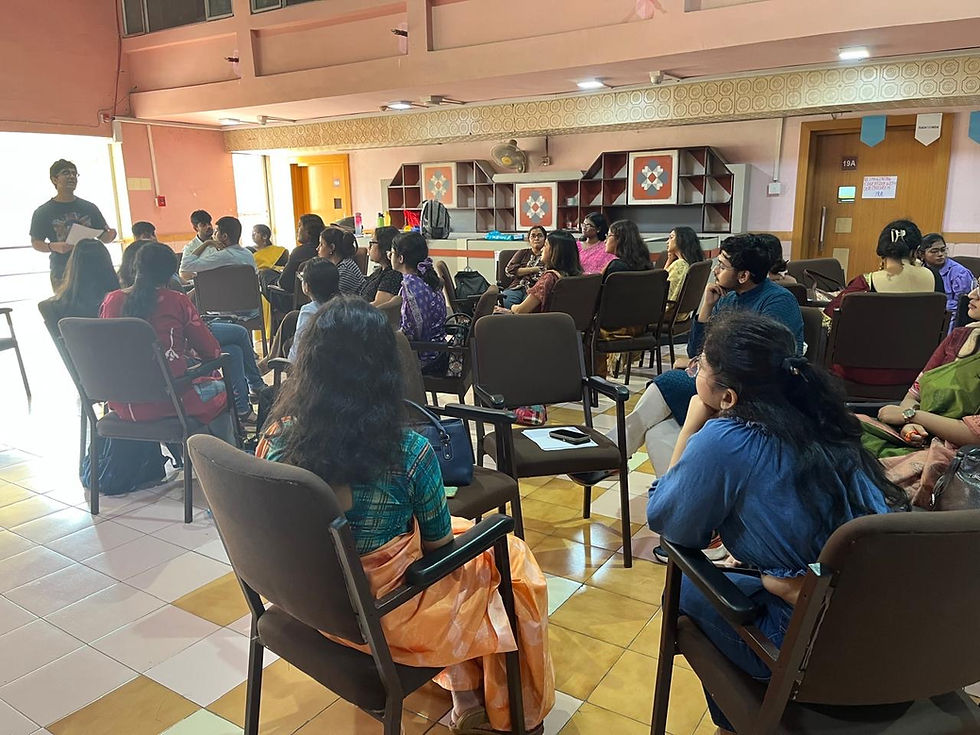
We run an annual Professional Development Course to create a space for teachers to exchange knowledge, gain pedagogical insights, share hope, frustration, courage. Conceptualized on the premise of peer to peer learning these courses also form solidarities.
Our goal is to inspire educators to resist authoritarian uses of history and to teach the past with an eye towards the present and a future that recognises and respects justice, empathy and citizenship. We are facilitating a pedagogy that is activist/intellectual in its approach, one that focusses on history teaching being inclusive and a site of contestation, memory, and identity.
The road ahead is long and difficult. This work is long term. There are no quick fixes. But we persist, because the stories we choose to tell our young will shape the kind of country we become.
Before I end I wish to share a young colleague's reflection
As a student, the classroom marked the haven of order, of discipline and routine, of textbooks and timetables. But what masquerades in the public domain as history was more attractive! There was something of a spectacle about it. It was theatrical, it made history urgent (like these were events that happened yesterday!). It was(is) bloodsport.
Through History for Peace—first as a student, then intern and now as a colleague, I have learned that, as Arundhati Roy once wrote, ‘Peace is War’, a slow relentless struggle to be heard, to listen to the pain of others, to feel discomfort so we may learn to empathize, for history to nevermore be a soft weapon of massacre and genocide.
I would like to share the story I often tell at teacher gatherings, as quoted by educational psychologist Haim Ginott, from a letter that a principal writes to his teacher at the beginning of each academic year.
‘I am a survivor of a concentration camp. My eyes saw what no person should witness: gas chambers built by learned engineers. Children poisoned by educated physicians. Infants killed by trained nurses. Women and babies shot by high school and college graduates.
My request is this: Help your children become human. Your efforts must never produce learned monsters, skilled psychopaths or educated Eichmanns. Reading, writing, and arithmetic are important only if they serve to make our children more human.’
And before I close, I have a small clip to share. My way of expressing gratitude towards all the wonderful academics from across the world who have who have selflessly shared their time, knowledge and experience with our network of teachers in India.
[i] Manjula Padmanabhan, Hidden Fires (Calcutta, India: Seagull Books Pvt. Ltd.) Aug 2003


Comments