


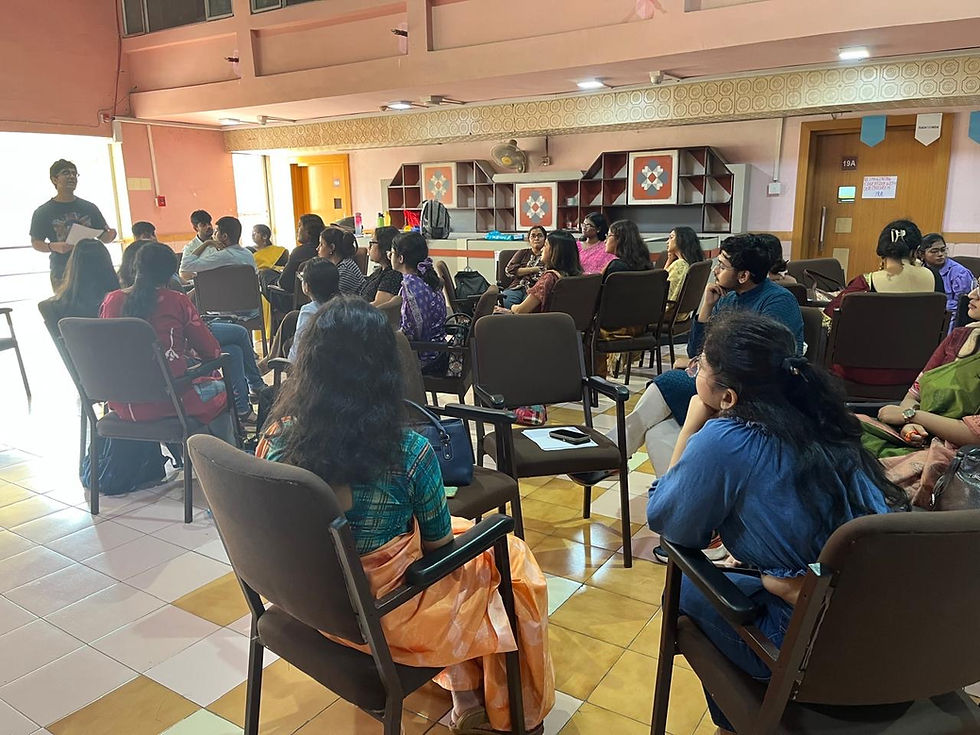
The following is a report of a workshop on 'History-Writing and Popular Memory' facilitated by Dr Aparna Vaidik at The Community Library Project, Delhi, on the 31st of January, 2026.

This interactive workshop led by Dr. Aparna Vaidik focused on the methods of writing history and its composite processes. Dr. Vaidik used the many histories of Mangal Pandey and the Revolt of 1857 as case studies to elaborate upon the relationship between memory and history.
All participants were given a leaflet containing questions about Mangal Pandey and his role in the Revolt. The first question asked participants to write down all that they already knew about Pandey. The discussion that followed foregrounded how Pandey has been remembered as a valiant freedom fighter of national importance, credited with being the first mutineer of the Revolt. This discussion was used as an opportunity to highlight how important ‘received wisdom’ is in our understanding of history and how a historian should first look at what already exists in popular memory to better engage with any historical event.
Dr. Vaidik then showed participants how limited authentic archival records were; the archives pointed to Pandey’s role in the larger rebellion being relatively minimal and unmistakably local. This challenged the existing narrative that revered him as a national hero responsible for the novel and widespread 'Sepoy Rebellion'. This thus highlighted the often spurious nature of inherited knowledge and its repetition in popular media.
The second question in the leaflet asked the participants about the sources via which they had learnt about Pandey prior to the workshop. Dr. Vaidik asked this question to show that his image has been constructed in popular imagination through school textbooks, stamps, memorial statues, films and publications like Amar Chitra Katha. Particular attention was paid to V. D. Savarkar’s The Indian War of Independence: 1857 (1909), located as one of the most influential texts that bred Pandey’s heroic status. The workshop discussion was steered towards understanding why Pandey was chosen as a symbol for the Revolt and the responsibility historians have in the process of knowledge production.
Participants were then made to interrogate what Pandey's dominant narrative invisibilised. Vaidik highlighted how the contribution of Adivasi women in the Revolt and the Santhal Rebellion are often neglected in most popular narratives. While popular narratives allow us to gain a more holistic understanding of history beyond official records, it also rejects the aforementioned narratives from the margins; it chooses a more convenient hero akin to Pandey.
Participants spoke about the importance of the often fraught relationship between trained historians and the public and how it aids and affects popular discourse. The workshop concluded with the participants’ and Dr. Vaidik's reflections on this workshop and the relationship between history and popular memory.


Comments