


- History for Peace
- Dec 23, 2025
- 3 min read
REFLECTIONS BY WORKSHOP FACILITATORS
12 years, 22 cities, over 500 teachers, over thirty thousand students.
Each time we are ready to take the Anne Frank—A History for Today project to a new destination, we tell ourselves, it’s about time we did something different, only to bring an element of newness and excitement for us—the facilitators. And yet each time we follow the same format and still find new insights and exhilaration from the interactions at the peer guide training workshops which is an integral part of the project.
At its core the project is an exemplary method of experiential learning and empathy building. Students immerse themselves in the history of 20th-century Germany and the life of Anne Frank through her diary to understand persecution and connect it to contemporary notions of identity, nationalism and belonging. The entire process of setting up a travelling exhibition and becoming guides to visitors leads to deep engagement and a sense of ownership of the project.

At Vidyagyan School in Bulandshahr students come from interiors of Uttar Pradesh and other rural regions where caste discrimination is a lived reality and questioning social order is impossible, particular for those as young as 13- to 16-year-olds.
The peer guide training offered the participants a safe environment to connect dots and reflect on labels that thus far they had normalized; question inherited identities and recognize bias. It gave them an understanding of how stereotypes are created and to what extent they are capable of being devastating.
Although we did not change the format of the project yet again, we hope that this time round we introduced the radical act of gentle disruption through history, storytelling and community engagement. One that we hope has opened a space for reflection for all those who pariticipated in the project—as peer guides and as visitors.
Megha Malhotra


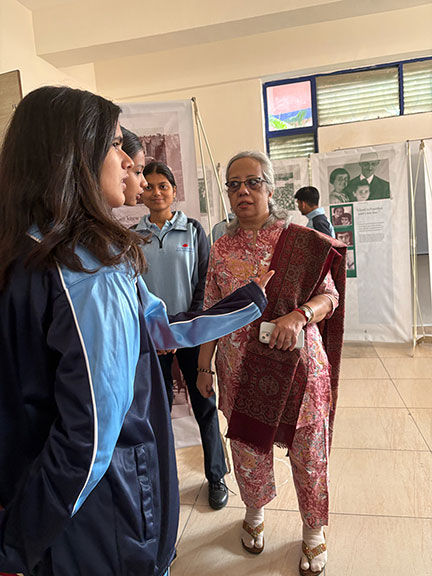

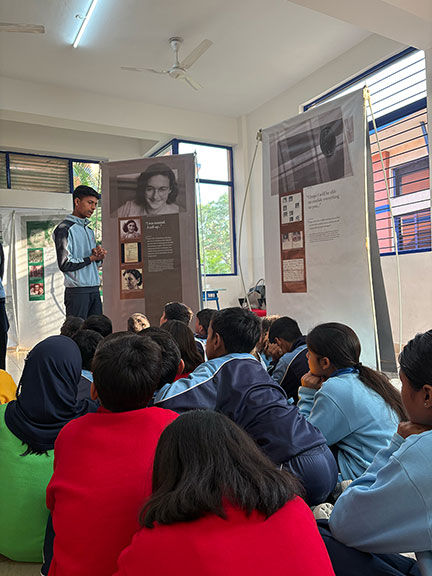

In the past I have sent many students to be trained as peer guides for the Anne Frank exhibition and only once, a very long time ago have I visited the exhibition myself. So, being this closely involved with the whole process was a completely new and revealing experience for me.
These are some of my thoughts:
What struck me was how this group of 13–14-year-olds was at times very different and at other times just like the ones I have taught over the years despite the differences in their background and circumstances. There was the same mix of a few who wanted to speak every time and others whose shyness or diffidence kept them silent. Yet it was clear that there was a sense of involvement in every student in the group, talkative or quiet.
I was also struck by how aware and sensitive they were about issues of bias, stereotyping, othering and related forms of discrimination and how candidly and lucidly they expressed themselves while sharing their stories and experiences. It seemed they had already given these issues some thought and understood that change was required.
I think the process of setting up the exhibition was a huge cooperative learning opportunity for the group, as well as a democratic decision-making exercise. Of course, this was largely because of Megha’s friendly yet firm guiding. There was a distinct feeling of achievement once all the panels were up and the exhibition was ready to roll!
The last, and possibly the most enduring memory of the exhibition for me will be the empathy shown by the peer guides in switching to Hindi while explaining the panels so that the students of class 6 who were not so fluent in English would be able to follow. And it was a further revelation when I realized they were not translating from the English narrative but actually spontaneously story-telling in Hindi!
Sunita Biswas


Comments