


- History for Peace
- Dec 23, 2025
- 5 min read
On History and Literature
History for Peace Regional Conference, November 2025.

Conference Report
The History for Peace regional conference, held in November 2025, was a significant academic gathering aimed at senior school students (Classes 9–12) and their educators. The central purpose of the programme was to dissolve rigid boundaries between history and literature, demonstrating that historical interpretation is deeply rooted in narrative construction. By foregrounding this perspective, the conference encouraged critical skills such as source analysis, recognition of bias and awareness of multiple historical viewpoints.
Day one established the intellectual foundation for the conference. In her opening address, Shashi Banerjee set the stage for a reflective engagement with the past, followed by an introductory framework by Meena Megha Malhotra.

Anubhuti Maurya’s was the first lecture of the day. She explored how history emerged as a scientific discipline only in the eighteenth century, while earlier societies embedded their historical understanding in oral tradition, religious texts and courtly records. She demonstrated this through multiple stories of the origin of Kashmir—from the 12th century Raag Ragini account of land emerging from water, to Abul Fazl’s depictions of society formation, to later mythic narratives invoking Prophet Suleiman and finally Narayan Kaul Ajiz’s focus on kinship in the eighteenth century. Maurya asked the central question: How does a historian choose meaning among conflicting versions? She stressed that history is reconstruction—an imaginative yet evidence-sensitive dialogue between the past and the present.Her talk also drew connections to Romila Thapar’s idea of ‘historical tradition,’ showing how Indian historiography moved from religious literature to courtly texts and regional documentations to the now focus of doing history. This echoed her central assertion that history itself can be a creative source for literature.
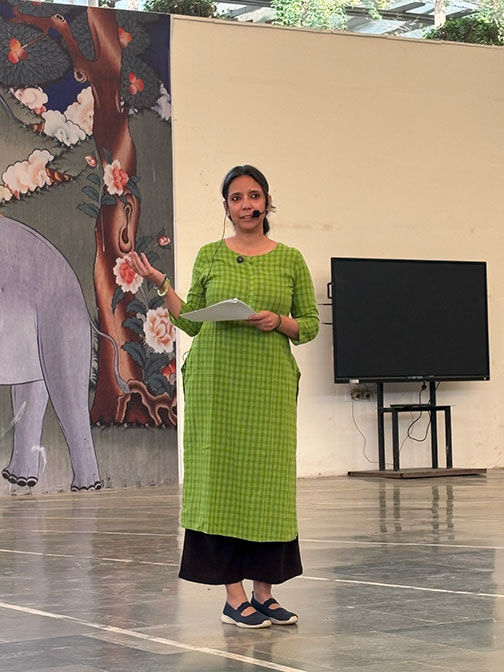 |   |
Next we had Komita Dhanda doing a performative reading of two versions of Shakuntala—one of Kalidas’s timid, gentle, epic heroine and the other of the strong, assertive woman from the Mahabharata. This effectively set the tone of the core idea behind the intersection of History and Literature explored by all the speakers at this conference.

Kanad Sinha followed with a pivotal lecture, The Historian and the Storyteller. He interrogated the impact of European scientific thinking on historical practice—raising provocative questions about whether the past can be observed or verified like a laboratory experiment. While acknowledging subjectivity and plurality in historical interpretation, he emphasized that historical narratives must rest on sources, not belief. His examples—from Ashoka’s inscriptions to the curious absence of his name in Buddhist texts—highlighted how historical truth depends on time of composition, language, political context and social realities. Sinha’s reading of early Indian literature, including the Vedic corpus and the Mahabharata, further demonstrated how imagination and memory blur into claims about the past.

The day culminated in a keynote address by poet and critic Ashok Vajpeyi, who invoked Octavio Paz’s insight that ‘poetry is active history.’ He went on to explain how history is exteriority—the public domain and poetry or literature is interiority—private domain.
Quoting Picasso, he noted that art is a ‘lie that tells the truth.’ Literature, he argued, preserves plural and inconvenient truths that state power may seek to suppress. In India’s tradition of plurality, he warned against accepting a single story or singular past. His concluding reflection remained memorable: the day we stop asking questions, we will cease to exist as a civilization.
The second day shifted from conceptual groundwork to ethical and political challenges of historical practice. Apoorvanand opened by discussing the politics of language. During the schooling years in our post-independence classrooms Hindi and Urdu are projected as two completely separate languages. However, once students enter the University and read Premchand, Mahadevi Verma and other great writers and study the history of literature the conflict between the past and present related to language becomes stark. He further explored the role of textbooks in shaping the histories that societies choose to remember or forget, urging students to confront the political nature of memory and its bearing on visions of the future. His talk was a scathing and necessary critique of the state of the domain of history under the current government in India—revisions in textbooks and what they mean; change in syllabus at the school, under graduate and post graduate levels; shutting down of departments such as the Study of Social Exclusion; the appointments in key positions across education institutes and the impact of all of this on the historical consciousness of our society. His discussion on the importance of separating belief from history turned volatile with some sections of the audience objecting strongly to his point of view.

A session titled Two Talks and a Conversation brought together constitutional lawyer Shahrukh Alam and historian Parvati Sharma. Alam offered a legal–historical perspective in The story of a trial: The 1857 Uprising and the trial of Bahadur Shah Zafar, revealing how law and history intertwine. Was law always ther? Is there a history of law?, she asked. She traced the changing nature of law and demonstrated law is power through examples that ranged from South Africa to Meghalaya. Sharma’s segment, Stay calm and trust nobody: how I learned from bias in history, presented practical strategies for navigating contradictory archives and evaluating historical claims to recognise bias in history.
 |  |

Their conversation was a powerful way to draw an end to the lectures section of the conference and the audience couldn’t help feeling this should have been a longer session as they reflected on each of the preceding talks over two days.
Workshops: Applying the Theory
Parallel workshops were an essential component of the conference, offering hands-on engagement with early Indian myths and texts. Kanad was joined by Bharathi Jagannathan to explore the theme of many Ramayans in-depth. Engaging closely with the Ramakatha tradition, some students wanted to change the ending of the Ramayana and were surprised to know that the sentiment was shared by the seventh century poet Bhavabhuti. Some were ready to question Rama's treatment of Sita and Shambuka, some pointed out their displeasure at receiving information that contradicted the ideas they carried, while others challenged everything the experts were saying.
Parvati took the theme of her lecture further by analyzing key events and perceptions from Mughal history to explore different kinds of bias—not only of writers and historians, but also of eras, nation states and even ourselves, as readers.
Shikha Sen delved into the realm of myth and history demonstrating through discussions and activities how the two overlap and how when imagination is mistaken for evidence, myths risk being accepted as history.
Sunita Biswas tapped into the universal appeal of folk tales to introduce the concept of how historians think. Through group activities and discussions, the students will compare these stories with traditional historical accounts to see what kind of an understanding of the past each provides.
Students and teachers practised extracting historical insights from literary sources, gaining confidence in interpreting primary material. The sessions promoted lateral thinking by inviting participants to compare cultural narratives with conventional histories and assess their evidentiary worth. The workshops encouraged teachers and students to appreciate the familiarity of the content while discovering new modes of reading them—with attention to nuance, contradiction and context.
Across two days, the conference successfully demonstrated that history and literature share a deep kinship. Far from being merely records of the past, historical narratives are constructed, contested and continually re-interpreted. Literature—whether oral tradition, myth, poetry or fiction—both shapes and challenges history’s truths. Through lectures, conversations, performances and workshops, students and educators engaged with this critical idea: our past is a story we must question, examine, and tell responsibly.


Comments