


- megha malhotra
- Dec 19, 2025
- 4 min read

After two years of online workshops, History for Peace organised the first in-person professional development course at Shiv Nadar School, Noida over 19th and 20th November, 2025. The overarching theme for the course was Sifting Fact from Fiction, particularly with a view to exploring ways in which educators in schools can enable students to question the historicity of current narratives about the past.
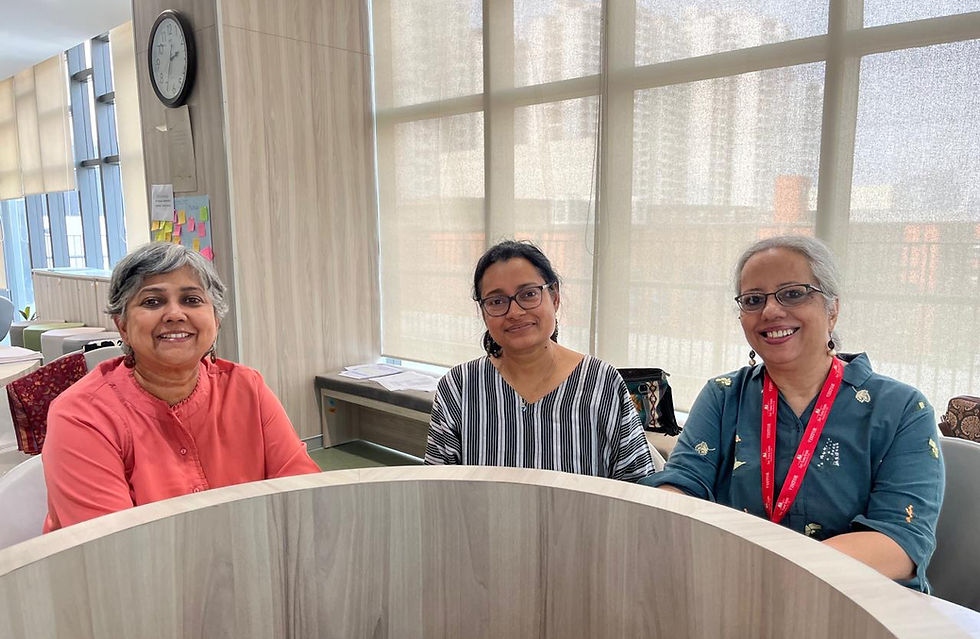
The first of the three workshops was facilitated by Gowri Mirlay Achanta from St. Joseph’s Boys High School, Bengaluru. She began by presenting two completely opposite accounts of Tipu Sultan’s religious policies and through critical questioning she got the participants to ponder, discuss and differentiate between fact and fiction. She then moved to the British in Bangalore and the racism inherent in the cantonment life. The group looked at pictorial sources and data from that era, particularly of schools, curriculums and faculty profiles, to answer questions about the true nature of the colonial legacy and whether it can be considered a bane or a boon. Her narrative, anecdotal approach, interspersed with thought-provoking questions, was engaging and the session saw many lively interactions especially around the new names of cities and the ever-provocative subject of the Koh-i-noor!.

Madhusree Dutta Majumdar from Vidyashilp Academy, Bengaluru, was the facilitator in the post lunch session. Her presentation was based on the concept of Understanding by Design as developed by Grant Wiggins and Jay McTighe. In this session the participants explored strategies to train students to move away from basic collection and recall of information to thinking deeply about big ideas and core concepts. With the help of a detailed presentation with many diagrams, well-designed handouts and structured activities, especially one around cupcake-making, she showed how students can understand the difference between knowing, doing and understanding and evaluate new information critically through evidence-based reasoning. She applied the UbD method to demonstrate how students can be taught not just what to think but how to think and thereby confidently sift truth from fiction. There was a high level of involvement throughout the workshop.

The third workshop was facilitated by Sunita Biswas from History for Peace. She began with a quiz on historical ‘facts’ commonly held to be true but which are not always so. The aim of this exercise was to think about why we believe what we believe, where we get our facts from and whether we stop to verify. This was followed by a brief discussion on how historians have looked at facts over the years and whether a historian retrieves facts or reconstructs them. After this the focus shifted to the textbook—that problematic and much-maligned but oftentimes the most easily accessible resource for the teacher in the classroom (and usually the only resource for most students!). Participants took a critical look at how the information in a textbook (in this case the new NCERT History textbook for class 8) is presented, including the facts of omission and commission and even the language use. The last segment of the workshop featured the biased and polarised representations of history in the media today that are contributing to rising intolerance and divisiveness.

The keynote address was scheduled at the end of the three workshops because of time zone differences. The two speakers Shwetangna Chakrabarty and Natasha Haque joined virtually via video-conferencing. They are both dynamic change-makers and thought leaders with many years of experience of working in diverse curricula across continents. Their work focuses on teacher capacity-building and creating culturally relevant curriculum. Their keynote address focused primarily on teacher-empowerment, particularly in the present when the recognition of teachers during the pandemic seems to have faded and complacency has set in again and the teacher’s voice is perhaps the least audible today. They stressed on continuous professional development which is rooted in the humanising local context that honours indigenous knowledge within the larger global framework. They urged teachers to reclaim the classroom and rethink what it could look like through reciprocal learning in an inclusive space that allowed students to question established norms and share their stories. In tune with the theme they talked about the emotions and agenda shaping the narratives and how the line between truth and fiction is getting blurred.

A plenary session was organised post lunch on Day 2 by the three facilitators. For this the participants had to work in groups on any idea or teaching strategy from the three workshops and develop a lesson plan around that. The course ended with the groups presenting their lesson ideas which were all very well-designed, with practical applications. A few groups even merged ideas from different workshops into a single lesson which was most interesting.


Tanya Burman, a participant from Shiv Nadar School Faridabad, has this to say about the two-day course:
All three facilitators articulated the challenges of navigating misinformation and “post-truth” narratives with remarkable precision and it provided an excellent foundation for the discussions that followed. The interactive activities of reading multiple perspectives, preparing a ‘cupcake’ lesson plan, or presenting a courtroom argument, were also well-crafted, allowing us to think practically about teaching in a climate saturated with misinformation. The references to unchecked popular narratives, students’ growing consumption of unreliable content and Sam Wineburg’s observation about our ‘age of boundless credulity’ felt especially timely and relevant.


Comments