


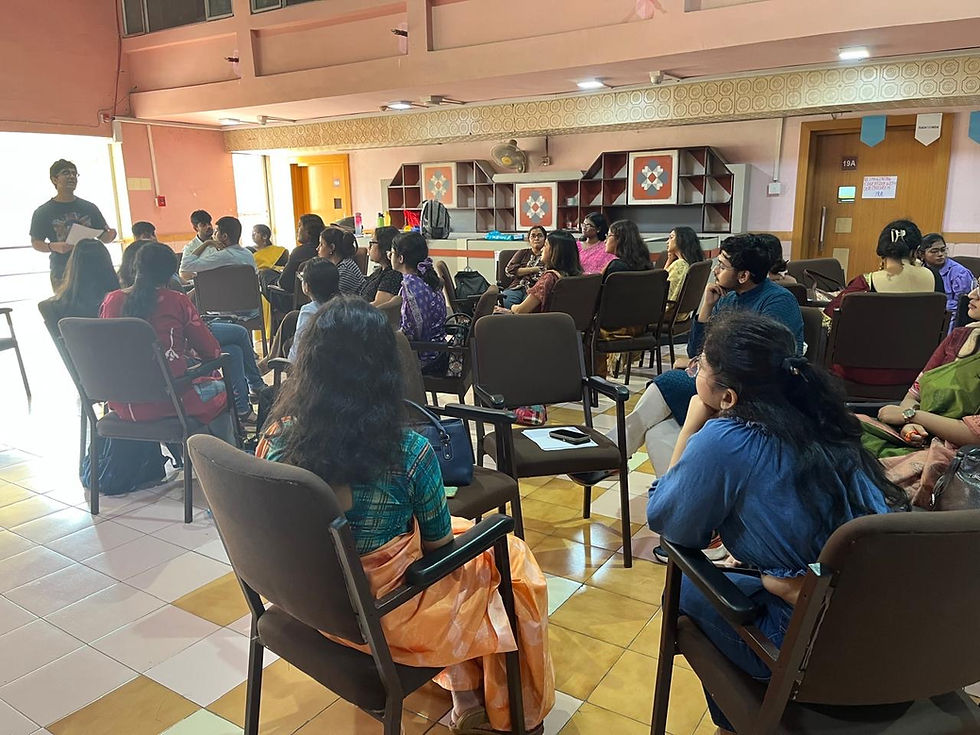
The following is a report of a workshop on 'Thinking About the Indian Constitution' facilitated by Dr Gautam Bhatia at The Community Library Project, Delhi, on the 28th of February 2026.

This workshop, led by constitutional law scholar Gautam Bhatia, aimed to critically analyse the Constitution of India as a non-neutral instrument of governance. Bhatia, in this session, located how the Constitution centralized its powers and urged the participants to review its character. Through this exercise, participants discussed and examined where ‘We the People’ stood in this document vis-a-vis power-allocation.
Earlier this year, the Tamil Nadu state government brought forth the issue of rising central power and decreasing federal power under the current administrative system. Bhatia used this example to highlight how the design of the Constitution in fact allows for the Centre to enjoy such power. He cited Article 293 to further his case: if a state is still in debt on account of a loan which had been lent earlier by the Government of India, Article 293 requires that state to receive consent from the Government of India before they raise any new loan. He suggests that this is one of the many constitutional means via which the Centre places indirect silent pressure on the state governments, thereby accumulating more constitutionally-vested power. Continuing with his discussion on the states, Bhatia explained the concept of asymmetric federalism. Seen in countries such as Canada, such a system gives varying degrees of power to the different states that compose a given nation. The Constituent Assembly in India believed this would be an unfavourable system to follow, following which all states were given equal powers under the Constitution. The only exceptions to this rule were a few North-Eastern States (Article 371) and Jammu and Kashmir (Article 370). Bhatia explained how these asymmetric exceptions were made to curb secessionist tendencies in border states and prevent civil war, allowing for the protection of social practices and land rights in these territories.
Bhatia also spoke on the limits of protest and dissent within our parliamentary system. The Constitution does create a weaker opposition, making it difficult to discuss the topics which the Centre does not favour. The apparatus of the Election Commission was also brought into the discussion; there is a constant struggle to make the Commission’s officers independent from the Centre and its growing power. He explained the limits of the Right to Information Act and the Central Information Commission and how it still prevents citizens from fully exercising their rights. After illustrating these imbalances in power systems, Bhatia analysed the Fundamental Rights and the Preamble of the Constitution.
The Preamble proudly asserts that the Constitution is a document of and for ‘We the People’. However, the term ‘People’ is not present in the Constitution after its mention in the Preamble; the collective is only alluded to in later sections like Part III where the Fundamental Rights are spoken of. Bhatia argued that the ‘People’ of the Constitution enjoy few effective powers and that the provisions made for the exercise of popular sentiment (via referendums and the like) are scarce.
Bhatia's last point was based on an examination of what the Constitution was silent on. He divided this silence into two aspects––one social and the other economic. The social aspect referred to the Constitution’s treatment of caste. While the Constitution does abolish untouchability, there remain certain cracks in its provision of affirmative action: the government can choose whether reservation should be implemented and it is under no compulsion to do so. Bhatia also documented the relative infrequency of the mention of caste in the Constitution, which is especially surprising given that the Constitution represents a country that has suffered for centuries on account of caste and its inherently discriminatory practices. The second silent aspect was economic. The Constitution ensured that the status quo of economic inequality continued to live on: industrialists and their industries continued to enjoy a variety of powers and privileges within the ambit of the constitutional framework. Bhatia argued that these silences still remain to enable predominant power structures within the nation.
The session ended with an interactive discussion with the audience. Participants spoke about the Anoop Baranwal vs. Union of India (2023) case and Bhatia highlighted the benefits and the drawbacks of the decision taken by the judiciary. The discussion moved to understanding other limits to the Constitution; how it serves only as a governance framework and often falls short in addressing pressing issues pertaining to administrative corruption, reservation requirements etc. Participants also discussed the importance of the citizens’ engagement with the Constitution via RTIs. Finally, Bhatia spoke about the various constraints that the judiciary has to work with and how the careful review and renewal of constitutional amendments could aid the ‘People’ of the Constitution. The workshop helped participants review and question their pre-existing notions of the Constitution and also understand the evolving and transformative character of the same.


Comments